The crypto world dreams of playing an essential role in the global economy, offering an alternative to dollars and pounds.
But alas, for many, the industry can feel impossible to understand because it is so technical. Read on to find bitcoin explained simply – demystifying the world’s biggest cryptocurrency. Can you turn Bitcoin into cash? This article will give you a detailed explanation.
Bitcoin explained
What is bitcoin in simple terms? Basically, bitcoin is a digital currency that has been created without the intervention of a central bank. While the Federal Reserve is responsible for the US’s monetary system, bitcoin does not have a single person or organisation in charge.
To understand the reason for this, it is worth looking at why bitcoin was created. In 2008, a person using the pseudonym Satoshi Nakamoto wrote a whitepaper setting out their vision for the cryptocurrency.
They imagined a world where people could make electronic payments to one another without using a bank or PayPal. This was in the immediate aftermath of a global economic crisis that was largely caused by deregulation in the financial sector.
Nakamoto imagined that one of the biggest advantages would be lower fees when payments are made. Running a bank is an expensive business – there are office expenses and security to think about – and these costs often get passed on to consumers. His vision was to make everyone their own bank and to create a system where middlemen would no longer be needed.
This brings us neatly to how bitcoin was created. In the very beginning, it took 30,000 lines of blockchain code to get the cryptocurrency off the ground – blockchain is the name of the technology that underpins bitcoin.
To cut a long story short, blockchain is a public, fully-digitised database of every single transaction that takes place on the network.
Bundles of transactions are placed into blocks and attached to the chain of blocks that came before it. A new block can only be added when a complex puzzle has been solved – and the first person to do so receives bitcoins as a reward.
Bitcoin simplified: How many bitcoins exist?
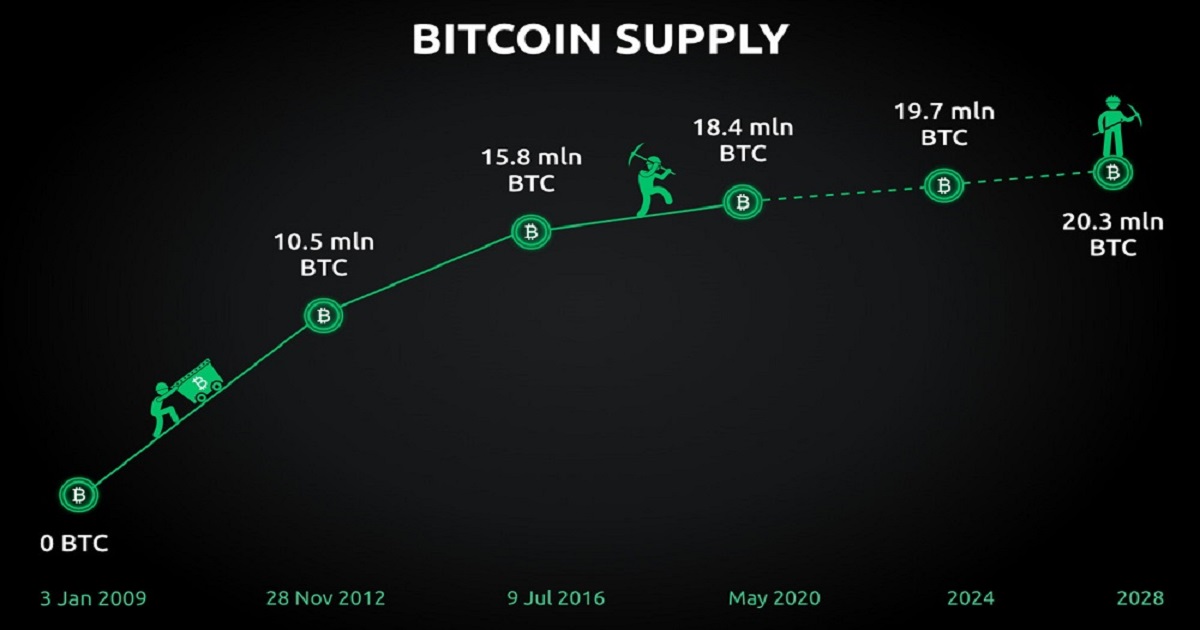
Just how many bitcoins are there? Well in easy, simple words, ever since bitcoin went live in January 2009, the total supply has been capped at 21 million. At the time of writing, over 18.999 million of them have been mined, according to CoinMarketCap.
Quick maths will tell you there are roughly 2.001 million yet to discover – and in the coming years, it is going to get harder and harder to find them. Estimates suggest the final bitcoin will be mined in 2140, roughly 118 years from now.
Fans of bitcoin argue that this is a refreshing change from what many central banks do, which is to effectively print more money. This measure, known as quantitative easing, often results in inflation, meaning things just end up getting more expensive.
Fixed supply increases value
By having a fixed supply, proponents claim that bitcoin manages to achieve digital scarcity – and that makes every coin more valuable as a result.
For a real-world example, just look at what has been happening with the coronavirus. Demand for hand sanitiser exploded at the start of the Covid-19 pandemic but the supply remained the same. Because of this, prices went up, making hand sanitiser worth more.
Before we move on, just a quick word about that supply of 18.999 million bitcoins that is supposedly in circulation at the moment. Although it is true they have all been mined, the number of bitcoins still active is likely to be a lot lower than this.
Data analytics firm Chainalysis estimates that about a fifth of all coins mined to date (somewhere between 2.78 and 3.79 million) are lost. Scarce indeed.
Bitcoin price history
Bitcoin has enjoyed a meteoric rise since its launch and is currently trading around the $46,500 mark.
In 2011, the price started at $0.30 per bitcoin. By the beginning of 2017, one bitcoin was worth approximately $998. In the winter of 2020, it reached nearly $20,000. By April 2021, one bitcoin would set you back $60,000. In July, the price fell to $30,000 before recovering to $50,000 in early September. And then came a new all-time high of $68,789.63 on 10 November, according to CoinMarketCap. A long-running bear market wiped a substantial chunk of value off the price of one bitcoin, and the coin hit an intraday low of $33,184.06 on 24 January 2022. However, there has been plenty of positive price movement since then, and at the start of April 2022 bitcoin is currently trading at $46,513.69.
Indeed, the fluctuations in the value of the world’s biggest cryptocurrency have been nothing short of a white-knuckle ride over the past decade or so. It is crazy to think that, in May 2010, you could get one whole BTC for a fraction of a cent.
Some people made a lot of money in the early days. Just look at Cameron and Tyler Winklevoss. The twins sued Mark Zuckerberg in the early 2010s and received a settlement that was reportedly in the region of $65m. Licking their wounds in 2013, they invested $11m of the cash in bitcoin, when it was trading at $120. Fast-forward four years and their BTC had risen by more than 10,000% – heading beyond $11,000 a coin. This made them billionaires. Who is laughing now?
One person who is trying to put a brave face on things is Laszlo Hanyecz, who will now forever be known as “Bitcoin pizza guy”. In an attempt to prove that bitcoin can be used to make everyday purchases, in May 2010 he stumped up BTC10,000 for two pizzas at Papa John’s. Of course, bitcoin was not worth all that much back then – but, at the time of writing, it is worth roughly $46,000. This effectively means he paid a whopping $460m for two pizzas. Ouch! Hanyecz maintains he does not regret it.
What affects the bitcoin price?
If you are completely new to crypto and need a simple bitcoin explanation, there is one question that you are probably dying to ask right now. How can a virtual currency go from being worth under a cent to being worth many thousands of dollars?
That is a very good question. Then again, you could say that for other assets, such as gold, silver or the banknotes in your pocket. BTC’s value has grown because it has all the characteristics of money.
There is one key point of difference: instead of putting your trust in a well-dressed banker, you are trusting a resilient system that has been built on mathematical principles. As the number of people interested in bitcoin grows – not to mention the businesses that accept it – the coin’s value will rise further.
Naturally, some other factors are at play. For starters, you have an event that is known as the halving. If you were paying attention a little earlier, you will remember miners get a BTC reward whenever they successfully solve the complex mathematical puzzle that adds a block to the chain.
In 2009, when bitcoin first launched, it stood at BTC50. But about every four years – every 210,000 blocks – this prize is slashed by 50%. It tumbled to BTC25 in November 2012, BTC12.5 in July 2016, and in May 2020 it fell to BTC6.25. The next halving will take place in 2024. After a halving, because there are fewer coins in circulation, the price increases because of higher demand.
Assuming demand for bitcoin remains strong, prices could continue to appreciate. Usually, the rise in value does not happen straight away – it takes about a year or so to properly kick in. As this Currency.com feature from 2020 explains in greater detail, BTC was 8,566% higher in the 12 months after the 2012 halving – and 286% higher after the event in 2016. After the halving in May 2020, the BTC price increased by nearly 120% by the end of that year.
This is not the only event that can serve as catnip for BTC prices. As it steps slowly closer to the mainstream, and so-called smart money continues to pour in, the value of the coin could increase even more.
Where to spend bitcoin
All of this brings us to the most consumer-friendly part of our feature on bitcoin explained simply: where bitcoin is accepted.
In early September 2021, El Salvador became the first country to make bitcoin legal tender. Merchants became legally mandated to accept payment in bitcoin alongside the dollar.
In the US, some big brands have begun to allow consumers to make purchases in BTC. Microsoft and PayPal, for example, have options to pay in bitcoin at the checkout. Tesla, similarly, announced a while ago that it would start accepting BTC to pay for its electric cars, but has since rescinded on the initiative because of the environmental downsides involved in the mining process. More recently, the company has said it would most likely begin accepting the coin again due to efforts being made by miners to use renewable energy.
Where to store bitcoins
First, much depends on what you are using bitcoin for. If you are buying it to invest short term over a period of a few days or weeks, then it is fine to leave it with an exchange.
However, if you are buying bitcoin because you think that in the long haul it will be worth a lot more money than it is now, then you need to think about investing in a wallet. The wallet is like an internet banking account. It is a space where you store your bitcoin and is protected by a code that acts as a password.
There are several different types of wallets, but broadly they fall into two different types – hot wallets and cold wallets. There are many different solutions, and you need to choose the most sensible and secure one for you.
Final thoughts
While some analysts see bitcoin reaching ever-increasing heights as it becomes the new digital gold, others see it as a mania that will fall away to nothing.
In easy, simple words, only time will tell whether bitcoin manages to tap into the mainstream – or crashes and burns after struggling to maintain its current valuation.
Do your own research and always remember your decision to trade depends on your attitude to risk, your expertise in this market, the spread of your investment portfolio and how comfortable you feel about losing money. Never invest more than you can afford to lose.