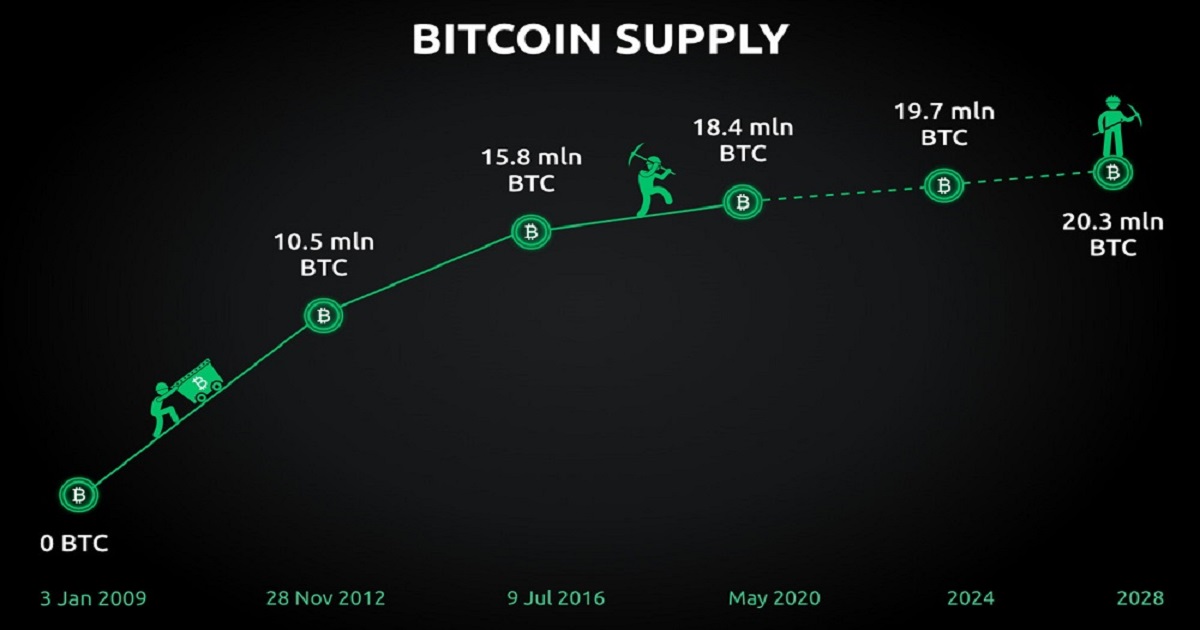
The maximum number of bitcoins that can be issued—mined—is 21 million. What could happen after Bitcoin runs out of all 21 million supply?
Today, more than 19 million Bitcoin have been mined to date, which only leaves under a few million remaining to be mined. Bitcoin miners earn revenue in two ways, newly minted Bitcoin from “block rewards” and from transaction fees of the users who transact on the network. The supply schedule for Bitcoin block rewards is defined based on the original code from Satoshi and is set up to decrease the reward that miners earn approximately every 4 years.
The algorithm that governs Bitcoin is set up so that every 10 minutes a new block is added to the Bitcoin blockchain and the miner that validates and adds that block earns the block reward. The current block reward is 6.25 Bitcoin per block, which means that every day, 900 new Bitcoin are added. After 210,000 blocks, the reward is cut in half, known as a “halving” event. The impact of a halving event is significant as miners immediately lose half of their revenue from block rewards. When Bitcoin was first released, the block reward was 50 Bitcoin per block, however, at the time the value of those rewards was significantly lower as the market price of Bitcoin was well under $100.
Based on the current schedule, all Bitcoin will be mined and in circulation by the year 2140, which leaves a significant amount of time ahead for the network to grow and become more globalized. In 2140, all of a miner's revenue will be associated with just the transaction fees on the network. Although there are no guarantees that transaction fees will ever supplement the current block rewards, many Bitcoin enthusiasts believe that significant development and growth of users will drive increased revenue for miners.
What will miners do when all the Bitcoin has been mined?
Once all 21 million Bitcoin have been minted, Bitcoin miners will still be able to participate in the block discovery process, but they won't be incentivized in the form of a Bitcoin block reward. That's not to say they won't be rewarded at all, though.
As well as block rewards, Bitcoin miners also receive all the fees spent on the transactions included in each newly discovered block. Currently, transaction fees make up a small proportion of a miner's revenues, since miners currently mint around 900 BTC (~$39.8 million) a day, but earn between 60 and 100 BTC ($2.6 million to $4.4 million) in transaction fees each day. That means transaction fees currently make up as little as 6.5% of a miner's revenue—but in 2140, that'll shoot up to 100%.
Losing the block reward won't disincentivize miners, according to Simon Kim, CEO of VC fund #Hashed. “Changes to the Bitcoin ecosystem and its place as a key currency in the virtual world could drive significant changes in miner adoption even after the block rewards stop" .