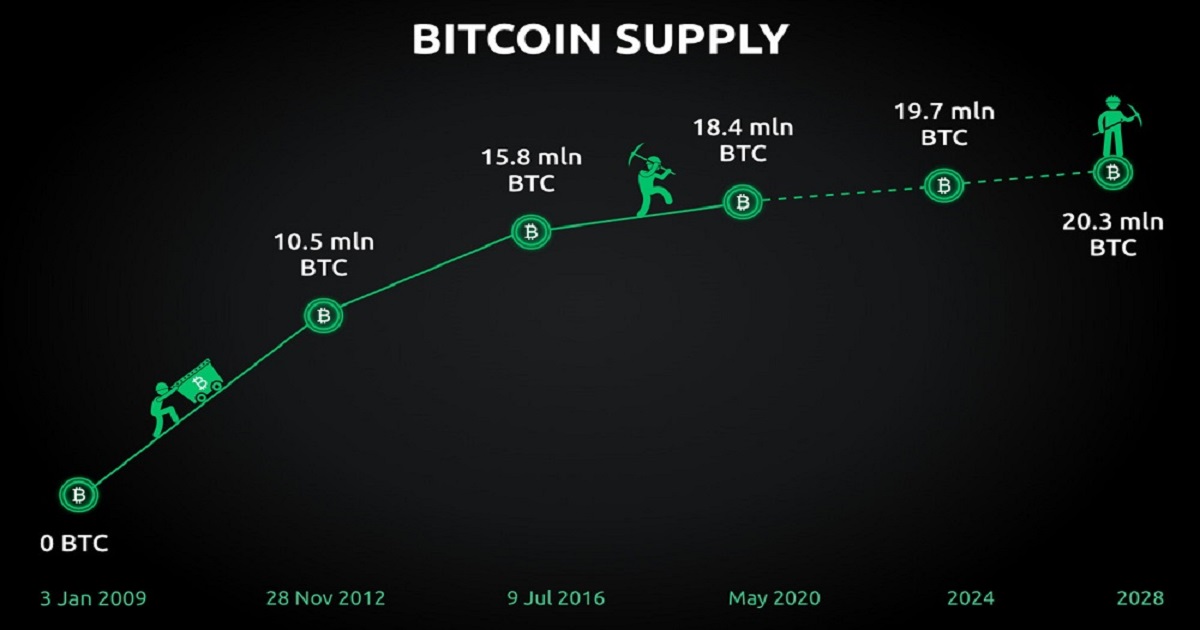
In this article, you will learn what is the definition of Bitcoin halving. Even though Bitcoin is digital money, it can't be created endlessly. Verifiable scarcity is core to its value proposition. There will only ever be 21 million bitcoin and the amount of new bitcoin added to the network will be reduced by half every four years . One of the most pivotal events on Bitcoin's blockchain is a halving.
What is the Definition of Bitcoin Halving?
After every 210.000 blocks mined, or roughly every four years, the block reward given to Bitcoin miners for processing transactions is cut in half. This event is referred to as halving because it cuts in half the rate at which new bitcoins are released into circulation. This is Bitcoin's way of enforcing synthetic price inflation until all bitcoins are released.
This rewards system will continue until around the year 2140. when the proposed limit of 21 million coins is reached. At that point, miners will be rewarded with fees, which network users will pay, for processing transactions. These fees ensure that miners still have the incentive to mine and keep the network going.
Why is Bitcoin Halving Important?
The halving event is significant because it marks another drop in the rate of new Bitcoins being produced as it approaches its finite supply: the maximum total supply of bitcoins is 21 million. As of late August 2022. there are about 19.1 million bitcoins circulation in , leaving just around 1.9 million left to be released via mining rewards.
In 2009. the reward for each block in the chain mined was 50 bitcoins. After the first halving, it was 25. and then 12.5. and then it became 6.25 bitcoins per block as of May 11. 2020. To put this in another context , imagine if the amount of gold mined out of the Earth was cut in half every four years. If gold's value is based on its scarcity, then a "halving" of gold output every four years would theoretically drive its price higher.
What Changes With Bitcoin Halving?
In the event that a halving does not increase demand and price, then miners would have no incentive. The reward for completing transactions would be smaller, and the value of Bitcoin would not be high enough.
To prevent this, Bitcoin has a process to change the difficulty it takes to get mining rewards, or in other words, the difficulty of mining a transaction. In the event that the reward has been halved and the value of Bitcoin has not increased, the The difficulty of mining would be reduced to keep miners incentivized. This means that the quantity of bitcoins released as a reward is still smaller, but the difficulty of processing a transaction is reduced. This process has proved successful twice.
Bottom Line
Bitcoin halving imposes synthetic price inflation in the cryptocurrency's network and cuts in half the rate at which new bitcoins are released into circulation. So, if you are interested in blockchain and cryptocurrency, this is about what is the definition of Bitcoin halving.