
$ 0.9973(0.00%)
RSV Price Chart
Reserve Market Information
$ 6.5900
0.00%
0.00%
0.00%
2430
4.0608
$ 426,566.11
427,703.80
Information
Issue Date
Initial Offering Price--
Max Supply
427,703.80
Circulating Supply427,703.80
Listed Exchanges0
Incentive Mechanism
Encryption Algorithm--
Reserve Price History
| Time | Change | High | Low |
|---|---|---|---|
| 24H | 0.00% | -- | -- |
| 7D | 0.00% | -- | -- |
| 30D | 0.00% | -- | -- |
| All | 0.00% | -- | -- |
About Reserve
RSV is a stablecoin backed by equal proportions of USDC, TUSDand PAX. It is created by the Reserve Project with a governance token called Reserve Rights Token (RSR).
As of January 2021, the market capitalization of RSV is only $1.5 million. This is small when compared with USDT with a market capitalization of $15 billion.
How to obtain RSV?
RSV can be purchased from exchanges such as Uniswapor Sushiswap. You can find RSV trading on various centralized and decentralized cryptocurrency exchanges.
What’s the future roadmap of RSV?
Reserve Project believes that the most responsible path to launch a decentralized digital currency is to start with a centralized fiat stablecoin, gather the necessary usage data, and use that data to evolve to a fully decentralized model. Below are the three phases in their roadmap:
The centralized phase - Reserve is backed by a small number of collateral tokens, each of which is a tokenized US dollar.
The decentralized phase - Reserve is backed by a changing basket of assets in a decentralized way, but still stabilized in price with respect to the US dollar.
The independent phase - Reserve is no longer pegged to the US dollar. It intends to stabilize its real purchasing power regardless of fluctuations in the value of the US dollar.
How does RSV maintain its peg to $1?
If the price of Reserve on the open market is lower than $1, arbitrageurs will be incentivized to buy it up and redeem it with the Reserve smart contract for $1.00 worth of collateral tokens. Arbitrageurs will continue buying on the open markets until the market price matches the redemption price of $1.00.
The same mechanism works in reverse when demand goes up. If the price of Reserve on the open market is higher than $1, arbitrageurs will be incentivized to mint new Reserve tokens for $1.00 worth of collateral and immediately sell them on the open market. They will continue selling on the open markets until the market price matches the purchase price of $1.00.
Reserve News

Invesco Files for Tokenized Fund to Back Stablecoin Reserves
Invesco has officially filed with the U.S. Securities and Exchange Commission (SEC) to launch the Invesco Stablecoin Reserves Onchain Fund, a new vehicle designed to offer stablecoin issuers a compliant way to manage their collateral.
Martha Grizzard |

Bybit Restores Ethereum Reserves After $1.4 Billion Hack
Bybit has announced the full restoration of its Ethereum (ETH) reserves.
Jerry McNeill |

Ohio Lawmaker Introduces Bitcoin Reserve Bill Allowing State to Buy BTC
Ohio Representative Derek Merrin has proposed a bill known as the Ohio Bitcoin Reserve Act.
Cornell Rachel |
Learn
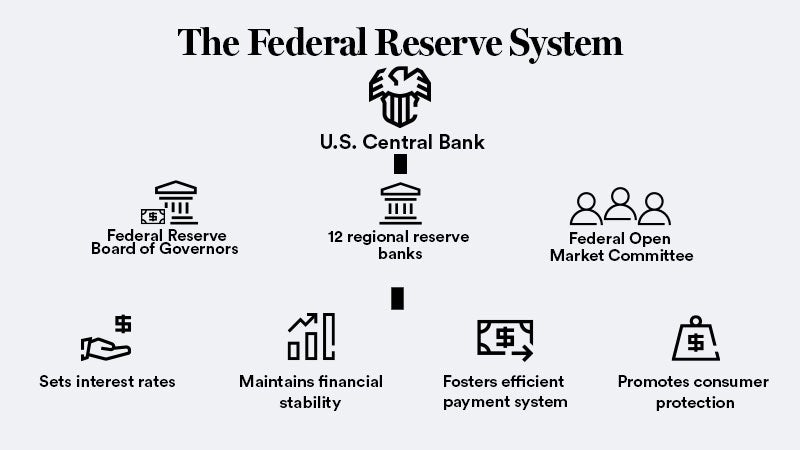
What is the Federal Reserve System and How Does It Work?
The Federal Reserve System, also known as the Fed, is the central bank of the United States. Let's take a closer look at this article for a better understanding.
Martha Grizzard |
Federal Reserve's Role in Banking Crises: What Causes Banking Crises?
The Federal Reserve, the central bank of the United States, plays a pivotal role in maintaining economic stability and preventing financial crises.
Jerry McNeill |
What is the Federal Reserve’s Jackson Hole Economic Symposium? Why is Jackson Hole Held?
This article is about what is the federal reserve’s Jackson Hole economic symposium. The financial headlines right now are dominated by talk of Jackson Hole.
James Dean |