
$ 0.002459(0.00%)
QKC Price Chart
QuarkChain Market Information
$ 0.3387
0.00%
0.00%
0.00%
576
88,651,122.91
$ 17,906,014.99
7,281,827,977.00
Information
Issue Date2018-06-05
Initial Offering Price$ 0.0198
Max Supply
0.00
Circulating Supply7,281,827,977.00
Listed Exchanges8
Incentive Mechanism
Encryption Algorithm--
QuarkChain Price History
| Time | Change | High | Low |
|---|---|---|---|
| 24H | 0.00% | -- | -- |
| 7D | 0.00% | -- | -- |
| 30D | 0.00% | -- | -- |
| All | 0.00% | -- | -- |
About QuarkChain
Project Overview
QuarkChain is a blockchain underlying technology solution based on sharding technology. It has the characteristics of security, decentralization, high throughput and scalability, and it will achieve transaction processing capacity of more than 100,000 chains per second (100,000+ TPS).
Project Highlights
QuarkChain's technical core includes:
1. Double-layer chain structure that can be sharded multiple times
QuarkChain consists of It consists of two layers of blockchain structure. The first layer is the shard layer (which can be understood as the sub-chain layer), which is used for transaction accounting; the second layer is a root chain, which is used to confirm the transactions in the shard. Without affecting the root chain, the number of shards in the sharding layer can be dynamically increased, thereby improving the overall throughput of the system.
2. Market-driven collaborative mining provides security
In order to ensure the security of transactions, QuarkChain has designed a game theory framework to motivate miners to work and allocate computing power reasonably mechanism, in which at least 50% of the entire network computing power will be allocated to the root chain to prevent possible double-spending and malicious mining attacks.
3. Anti-centralization horizontal node expansion
On any blockchain network with high TPS processing capacity, a super node that saves the entire network ledger will be very important. Expensive, which leads to centralization. In order to avoid this problem, QuarkChain supports multiple cheap nodes to form a cluster to realize the function of a super node, avoiding centralization.
4. Efficient cross-shard transactions
QuarkChain network supports cross-shard transactions at any time and anywhere, and completes transaction confirmation quickly. Transaction speed will increase linearly as the number of shards increases.
5. Simple account management method
In the QuarkChain system, each user only needs to create one account to use the entire blockchain network. Users' encrypted assets on different shards will be securely stored in a smart wallet, and the experience is like trading on a single chain.
6. Turing-complete smart contract platform
QuarkChain supports Turing-complete smart contracts, and adopts the Ethereum Virtual Machine (EVM) to integrate existing EVM DApps are easily migrated to the QuarkChain platform.
Technical Highlights
QuarkChain team has built its own unique core multi-chain technology, proposed Boson Consensus, and supports the following functions:
1. High flexibility, QuarkChain adopts the root chain-sharding structure. Both the root chain and shards can adopt their own single-chain consensus mechanism (PoW, PoS, dPoS, BFT, etc.), and can be continuously added according to business needs;
Second, high interoperability, QuarkChain Native support for efficient cross-shard transactions, ordinary users do not need to understand the difference between cross-shard and intra-shard transactions, and different slices can have different functions; 3. Security, we have proved from a mathematical point of view , all cross-slice and intra-slice transactions can enjoy the global security of the network.
Among them, high flexibility also means that, in addition to the public chain field, the Boson consensus can be widely used in fields including alliance chains, private chains and so on.
As the first implementation of the Boson consensus, QuarkChain has reached the production level:
1. The mainnet was launched at the end of April 2019, and by October, it has experienced two The second largest upgrade has been running stably for almost 6 months.
Second, there are more than 50 nodes in the network statistics, and more than 70% of the nodes are run by the community.
3. The mainnet seamlessly supports cross-shard transactions, including cross-shard contract calls (you can use the web wallet mainnet.quarkchain.io or mobile wallet QPocket to experience it at any time)
4. Several well-known exchanges have already supported the mainnet, including: Upbit, Gate.io, KuCoin, MXC, Piexgo, etc. Users can deposit and withdraw coins through intra-chip or cross-chip transactions. So far, there have been no serious issues reported by exchanges (such as lost coins, inability to join and sync the network, etc.).
5. The Go version of QuarkChain has been basically developed (now it is provided by Python development) and open sourced. It is worth noting that most blockchain projects were developed in only one language in the early stage (for example: Bitcoin uses C++, Cosmos uses Go, Polkadot uses Rust).
QuarkChain News
Solana Mainnet Launches Alpenglow to Cut Finality Time
Solana switched on its Alpenglow upgrade on October 21, 2026, replacing the way its validators agree that a transaction is final. Validators are the computers that run the network, and finality is the point where a transaction can no longer be reversed.
James Dean |
Switzerland Unlocks Retail Access to a Direct Bitcoin ETF
Switzerland's Financial Market Supervisory Authority (FINMA) approved the country's first retail exchange-traded fund that invests directly in bitcoin on October 20, 2026.
Martha Grizzard |
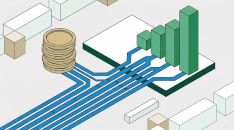
Stablecoin Payments Jump 45% to $482 Billion Despite Flat Supply
Stablecoin payments reached $482 billion from January through September 2026, up 45% from the same period in 2025.
Sherry Cantwell |
Learn

What is the Descending Triangle Pattern? What is the Ascending Triangle Pattern?
Ascending and descending triangles are the two most common right-angle chart patterns. Learn how to draw them correctly, confirm breakouts instead of guessing, project targets with the measured move, and control risk when the pattern fails.
James Dean |

What is Bitcoin Pizza Day? Who is Bitcoin Pizza Guy?
Bitcoin Pizza Day marks the first documented purchase of a physical item with bitcoin. Learn what happened on May 22, 2010, how much 10,000 BTC was worth then and later, and who the Bitcoin Pizza Guy really is.
Craig Green |

What is Polymarket? Can It Predict the Future of Crypto?
Polymarket is a decentralized prediction market on Polygon where users trade Yes/No shares on real-world events. Here is how it works, how accurate its prices are, its crypto limits, and its legal status.
Barry Stidham |
Frequently Asked Questions
What Is The Current Price of QuarkChain?
Can I Buy QuarkChain on BitKan?
How Can I Stay Updated on QuarkChain's Latest Price and News?
Why Does The Price of QuarkChain Go UP and Down?
How Do I Store QuarkChain?